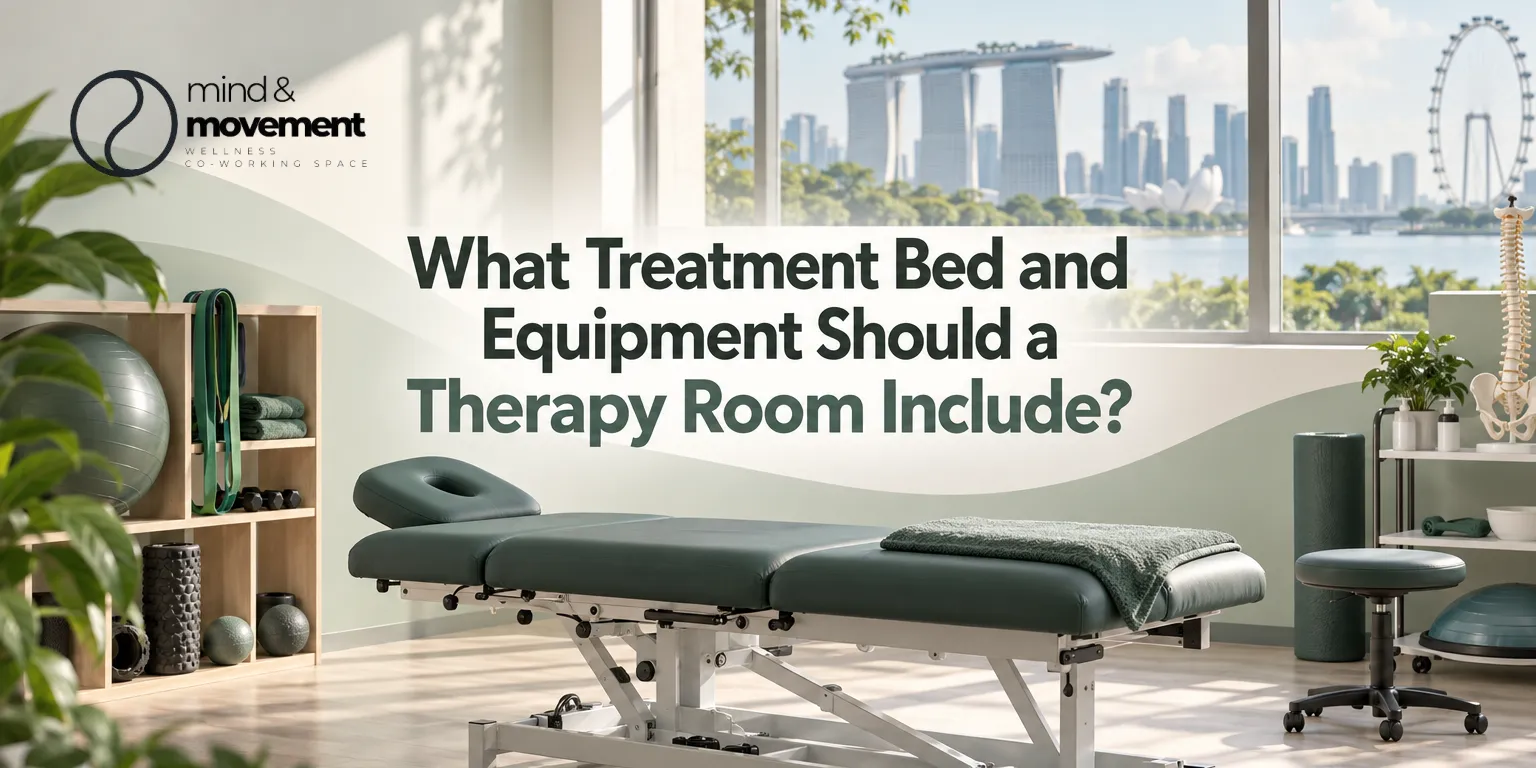
A therapy room should include an electric height-adjustable treatment bed with a face hole and wipeable upholstery, plus clean linen, bolsters, storage and client amenities. A treatment bed is the single most-used piece of therapy room equipment in any practice, and choosing the wrong one slows down every session you run on it.
Most independent therapists in Singapore now rent rather than buy. A ready-furnished room removes the lease, the renovation and the equipment list from your overheads. But rooms are not all set up the same way. The gaps tend to show mid-session, when a client is already on the bed.
A bed that will not drop low enough, a missing face hole, or nowhere clean to store your oils are small things on paper. Across a full day of clients, they compound into sore backs, slow turnarounds and a practice that looks less polished than it is.
Here is the checklist we work from. It covers the treatment bed features that matter most, the core kit every room should carry, discipline-specific needs, the Singapore practicalities to verify, and the 2026 hourly rates for equipment-inclusive rooms. In this blog, we discuss the treatment bed and equipment standards we apply when outfitting therapy rooms at Mind & Movement.
Table of Contents
Why Does the Treatment Bed Anchor Your Therapy Room Setup?
Because every hands-on technique happens on or beside it. No other item touches your posture, your client's comfort or your pacing as much.
In practice, we see practitioners agonise over paint colours, then book a room with a fixed-height bed. Within a fortnight the lower back complains. An electric bed is not a luxury; it protects both ends of the treatment relationship.
Electric frames start the session at transfer height and finish at working height. Fixed beds force a compromise on one end or the other. Shared rooms also favour lockable wheels, since several disciplines may use one space in a day.
1. Electric height adjustment
A motorised frame drops to knee height for less-mobile clients and rises to protect your back. Look for a smooth, quiet motor. Jerky movement breaks a relaxed client's state mid-technique.
2. Bed width and load rating
A usable width of 60 cm or more gives room for side-lying work and larger clients. Check the stated maximum load. It carries your downward pressure as well as the client's weight.
3. Face hole and cushion set
A face hole with a plug lets clients rest prone without strain, then converts the bed for supine work. Bolsters and a pregnancy cushion multiply your positioning options.
4. Hygiene and upholstery
Seam-free vinyl wipes down completely between clients. Pair it with a fresh disposable sheet per session and turnover stays fast. Torn seams age a room faster than anything else.
5. Mobility and brakes
Lockable wheels let you shift the bed within a shared room. That matters when you rent by the hour and the space serves several practitioners back to back.
What Basic Equipment Should a Therapy Room Include?
Beyond the bed, a working room needs clean linen, somewhere to store your tools, and a few client amenities. Every one of our therapy rooms and studios carries the basics below, so you only bring what is personal to your practice.
The detail worth insisting on is per-session linen. A disposable bed sheet plus fresh towels, one bath-size and one face-size, should come standard with each booking. If you are laundering your own, the room is quietly costing you time.
We have also written a fuller walkthrough of what to look for in a professional therapy room before you commit. Read it alongside this checklist when comparing venues.
1. Linen and consumables
Towels, a disposable sheet, paper roll and a bolster or two. These disappear fastest, so confirm they are replenished rather than billed separately.
2. Client amenities
Fast WiFi, a waiting area, a changing room and a water dispenser. Clients judge the practice before you touch them, and these are what they see first.
3. Storage and work surfaces
A lockable cupboard for oils, tools and session notes, plus a bench or shelf for your laptop. Your notes stay private and your kit stays organised between clients.
4. Lighting, sound and privacy
Warm, dimmable lighting and a door or curtain that actually closes. Sound privacy matters in manual therapy, where clients talk more than they expect to.
Treatment Bed Features to Check Before You Book
| Bed feature | Why it matters | Who needs it most |
|---|---|---|
| Electric height adjustment | Low start for transfers; high finish for your back | Every hands-on discipline |
| Usable width of 60 cm or more | Room for side-lying work and larger clients | Osteopaths, massage therapists |
| Clearly stated load rating | Stability under client weight plus your pressure | All disciplines |
| Face hole with plug | Comfortable prone positioning for face-down work | Massage and manual therapists |
| Seam-free vinyl upholstery | Full wipe-down hygiene between clients | All disciplines |
| Lockable wheels | Repositioning within a shared, multi-use room | Practitioners sharing a room |
How Do Equipment Needs Differ by Discipline?
A physiotherapist, a massage therapist and an osteopath can share one room. But each discipline loads different equipment, and the room should flex toward whoever is booked.
Physiotherapy leans on the electric bed plus bolsters, and often on apparatus. Rehab that blends manual therapy with movement needs a reformer or trapeze table within reach. Our hybrid rate covers the therapy room and the Pilates apparatus together, which suits exactly that workflow.
Massage and manual therapy lean on the face hole, the towel supply and somewhere to keep oils warm and hidden. Osteopathy and structural bodywork add width and load demands, because technique pressure goes through the frame.
Movement instructors sit in between. Reformer access matters more than the bed, though the therapy rooms still serve pre- and post-session assessment well. Our studios carry reformers from reputable brands such as Balanced Body, with trapeze tables, chairs and barrels shared between practitioners.
If you practise bodywork specifically, our massage therapist room rental page details what those sessions include. Healing therapists offering gentler modalities should likewise check the treatment room setup before booking.
Core Equipment by Discipline
| Discipline | Must-have | Worth confirming |
|---|---|---|
| Physiotherapist | Electric bed, bolsters, clean linen | Pilates apparatus for rehab blended with movement |
| Massage or manual therapist | Face hole, towel supply, oil storage | Dimmable lighting and sound privacy |
| Osteopath or bodyworker | Stable wide bed, strong load rating | Bolsters and pregnancy cushion options |
| Movement and rehab instructor | Reformer access within the same booking | Shared apparatus etiquette and booking system |
What Should You Verify Before Booking a Room in Singapore?
Three checks matter before you commit: the room's contents, its location, and the rules attached to your own practice. Rooms differ, even within one venue, so confirm each in turn.
The Ministry of Health (MOH) regulates healthcare services under the Healthcare Services Act, so confirm whether yours needs a licence.
Location first. Each of our three central locations sits minutes from a Mass Rapid Transit (MRT) station: Orchard at Palais Renaissance, Raffles Place at Grand Building, and Somerset at 111 Somerset.
1. Access and operating hours
Minutes from an MRT station cuts no-shows. Also check evening and weekend access, lift access for less-mobile clients, and where your clients can wait comfortably.
2. Licensing and client records
Licensing stays your responsibility. The Personal Data Protection Commission (PDPC) administers the Personal Data Protection Act (PDPA), which covers the client records you keep.
3. Room-to-room differences
Facilities vary by room and location. Confirm what your specific room includes before the first session. Never assume it matches another room you have used, even in the same building.
Pre-Booking Checklist for a Singapore Therapy Room
| Check | Question to ask | Why it matters |
|---|---|---|
| Treatment bed | Is it electric, and how wide is the usable surface? | The bed drives posture and pacing all day |
| Linen | Are sheets and towels included per session? | Avoids laundering costs and last-minute scrambles |
| Amenities | Is there WiFi, water, a waiting area and changing room? | Shapes client experience before and after treatment |
| Access | How many minutes from the MRT station? | Central sites reduce no-shows |
| Licensing | Does my service need a MOH licence? | Licensing stays the practitioner's responsibility |
| Booking terms | Can I hold a recurring weekly slot? | Continuity matters for regular clients |
2026 Therapy Room Session Rates at Mind & Movement
| Session length | Therapy room | Physio with Pilates equipment |
|---|---|---|
| 30 minutes | Not offered | S$35 |
| 45 or 60 minutes | S$42 (60 min) | S$45 |
| 75 minutes | S$52 | S$55 |
| 90 minutes | S$62 | S$65 |
| 120 minutes | S$84 | S$90 |
How Do Hourly Rental Costs Compare in 2026?
In 2026, equipment-inclusive therapy rooms at Mind & Movement start at S$42 for a 60-minute session. The fee covers the room, the electric treatment bed, a disposable bed sheet and fresh towels. A 60-minute booking gives roughly 55 minutes of treatment time after clearing the room.
Physiotherapists who blend manual therapy with Pilates apparatus pay a hybrid rate. It runs from S$35 for 30 minutes to S$90 for 120 minutes, with one rate covering bed and apparatus together. The hybrid rate is S$45 for either a 45-minute or a 60-minute session.
Movement practitioners have their own ladder. Reformer self-practice starts at S$35 an hour, duet sessions run S$65, and the Raffles Place group room runs S$75 an hour in 2026. Membership plans offer discounted hourly rates, with credits valid for six months.
If you also host groups, workshop space costs S$80 an hour, S$280 for four hours or S$480 for a full eight-hour day. The workshop space rental covers a projector, chairs, a whiteboard and mats for up to 20 participants.
The model exists for renting to independent instructors and solo therapists: book by the hour, by the day, or as a recurring weekly slot, with no lease and no equipment investment. Practitioners who rent therapy rooms and reformer studios by the hour usually settle into a weekly slot within a month.
Before committing either way, compare therapy room packages against pay-as-you-go rates for your expected volume. A heavy weekly diary can make a membership cheaper than drop-ins, and the reverse holds when you are starting out.
Conclusion
The bed anchors the room; the linen, storage and amenities are the quiet differentiators. Nail those and your practice feels professional from the first session, whether you book weekly or monthly.
None of it needs to sit on your balance sheet. Therapy room sessions start at S$42 for 60 minutes in 2026, with the electric bed, disposable sheet and fresh towels included, plus a hybrid rate for physiotherapists who add Pilates apparatus.
If you want a space where the therapy room equipment is already sorted, come and see the rooms at Orchard, Raffles Place or Somerset. Tell us your discipline and usual session length on WhatsApp, and we will match you to a room that fits how you work.
See the Rooms Before You Book
Tell us your discipline and usual session length, and we will match you to a room with the right bed, linen and amenities for your practice.
Frequently Asked Questions

Mind & Movement
Author
The Mind & Movement editorial team writes practical guides for independent therapists, instructors and wellness practitioners running their own practice from a rented space in Singapore, covering rooms and studios, locations, bookings and the day-to-day of building a practice.