A new Massage Establishment Licence costs $290 for one year under the fee schedule the Singapore Police Force introduced on 1 April 2020. The same regulator warns that money already spent on renovation, equipment or rental of premises will not strengthen your application. In other words, the sunk cost of committing to a space too early is a risk the authorities have publicly flagged.
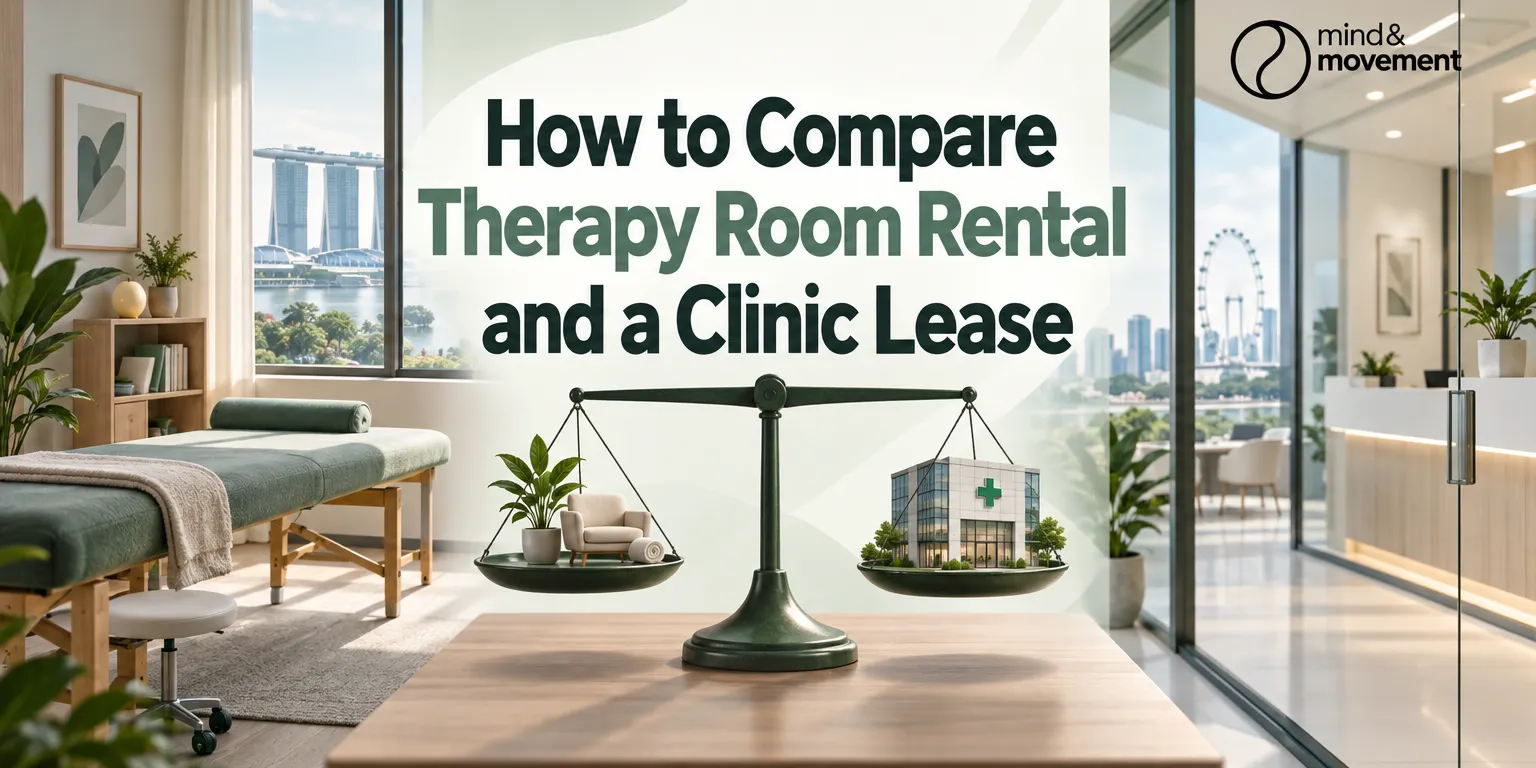
For an independent practitioner, that warning lands on the biggest decision you face: sign a clinic lease, or book therapy rooms as you need them. A lease asks for a security deposit, a multi-year term and a fit-out before you have seen a single client. Hourly therapy room rental asks only for the hours you actually book.
The wrong call is expensive in both directions. Lease too early and fixed costs eat a caseload that has not grown yet. Rent indefinitely at high volume and you may pay a premium for flexibility you no longer need. The right answer depends entirely on your numbers.
Key takeaways:
- Rental keeps fixed costs low while your caseload grows.
- A lease can win on cost per session only at high, predictable volume.
- Verify licensing, premises use and access before any money moves.
In this blog, we discuss what each option actually includes, where lease costs hide, how to run the numbers on your own caseload, and the Singapore-specific checks worth completing before you sign anything.
Table of Contents
What Does Therapy Room Rental Include That a Lease Does Not?
A rented therapy room arrives finished; a leased clinic arrives empty. That single difference drives most of the cost gap between the two models.
With hourly therapy room rental in Singapore, a typical booking gives you a private, equipped room for the hours you use. Mind & Movement's rooms, for example, come with an electric treatment bed, comfortable seating, warm lighting, fast WiFi, towels where available and a shared waiting area. Rates and inclusions vary by room and location, so confirm current details when you book.
A clinic lease gives you a shell. Before the first client arrives, you cover renovation, furniture, equipment, signage and utility setup. Our space rental options exist precisely to remove that list from your balance sheet. If you are weighing a professional therapy room against a conventional clinic unit, the checklist in our guide to choosing a therapy room covers the practical requirements to look for before you book.
Which Costs Stay Hidden in a Clinic Lease?
The visible rent is only part of a lease's true cost. Most of the risk sits in the money spent before opening, and the fixed sums that follow every month afterwards.
The sunk-cost problem is real enough that the Singapore Police Force, which administers the Massage Establishment Licence, explicitly warns applicants not to spend on premises before approval is granted. Renovation, equipment and rental already paid will not help an application. They cannot be recovered if the licence is refused.
The licence fees themselves are fixed and modest: $290 for one year, $440 for two years and $590 for three years, non-refundable, under the revised schedule effective 1 April 2020. Factor roughly four weeks of processing into any opening date.
1. The deposit and the multi-year term
Commercial leases in Singapore typically require a security deposit and a term of several years. Once signed, the rent is due every month, whether your booking sheet is full or empty.
2. Fit-out and equipment
A leased unit starts as a shell. Treatment beds, lighting, partitions, storage and reception furniture all come out of your pocket before the first session is billed.
3. Utilities, upkeep and quiet months
Electricity, water, cleaning and maintenance become your line items. In a rental they are folded into the hourly rate; in a lease they never stop, even in a slow month.
4. The licensing timing risk
Licensing is the sharpest hidden cost of all. A licence refusal after fit-out can write off an entire renovation budget. That is exactly why the regulator tells applicants to secure approval before spending on premises.
Therapy Room Rental vs Clinic Lease: What Each Includes
| Item | Therapy room rental | Clinic lease |
|---|---|---|
| Treatment bed | Included and ready to use | You buy and maintain it |
| Furniture and lighting | Provided | Fit-out is yours to arrange |
| Utilities and WiFi | Included in the booking | Separate monthly bills |
| Cleaning and upkeep | Handled by the venue | Your responsibility |
| Setup time | None — book and practise | Weeks to months of fit-out |
| Commitment | Per hour, day or weekly slot | Multi-year lease with deposit |
How Do You Run the Numbers on Your Own Practice?
You settle the comparison with a spreadsheet, not a rule of thumb. Your caseload, not the market average, decides which model wins.
For a fuller breakdown of therapy room rental costs, our budgeting guide covers the line items practitioners most often miss. If you are starting a therapy practice without a long lease, the same arithmetic applies: your caseload, not the market average, decides which model wins. Then work through these five steps:
- Estimate the monthly hours you can realistically fill — your average month, not your best week.
- Multiply by the current room rate to get your direct monthly room cost.
- Add the practice costs you carry regardless of tenure — insurance, consumables, admin and marketing.
- Total the lease alternative — deposit spread over the term, monthly rent, fit-out, utilities and staffing.
- Stress-test a slow month at half your expected volume, and see which model still lets you sleep at night.
For a quick break-even check, divide your all-in monthly lease cost by the hourly room rate. For example, a $3,600 monthly lease cost and a $45 hourly room rate gives a break-even point of 80 booked hours a month. Below that level, rental costs less on room use alone. Above it, a lease may become cheaper once you have allowed for fit-out and other upfront risk.
Where the Money Goes in Each Model
| Cost category | Therapy room rental | Clinic lease |
|---|---|---|
| Upfront payment | The hours you book | Security deposit and advance rent |
| Renovation and fit-out | Not required | Full fit-out before opening |
| Equipment | Basics provided; bring specialist items | Everything is your purchase |
| Quiet months | Book fewer hours | Rent is still due |
| Scaling up | Add hours or try a location | Term and floor space constrain you |
Who Suits Room Rental, and Who Should Lease Instead?
Rental suits practitioners whose volume is still uncertain; a lease suits practices with predictable, high utilisation. In practice, the split usually falls this way:
1. New and part-time practitioners
Paying only for booked hours keeps fixed costs near zero while the caseload grows. If a month is quiet, you simply book fewer hours and protect your cash.
2. Practitioners testing a location
A central, MRT-linked address cuts late arrivals and cancellations. Renting lets you test demand around Orchard, Raffles Place or Somerset before staking a lease on it.
3. Established, high-volume practices
Once utilisation is consistently high, a lease can lower your cost per session. At that stage, the spreadsheet should make the call, not sentiment.
4. Instructors and workshop hosts
Courses and certifications need capacity, mats and a projector, not a treatment room. Our guide to renting to independent instructors covers how instructors and hosts use shared spaces instead of leases. Our venue rental guide for wellness educators walks through finding a space for classes and workshops.
Singapore Checks Before You Commit
| Check | Why it matters |
|---|---|
| Massage Establishment Licence | Generally required to provide massage services in an establishment unless an exemption applies; $290 for a one-year new-licence application under the schedule effective 1 April 2020 |
| Premises use approval | Confirm the unit's approved use permits your practice before any money moves |
| Access hours | Evening and weekend access determines when you can actually generate income |
| Storage | Shared spaces rarely hold stock; bring and remove your own consumables |
| Client data (PDPA) | Client records must be handled under the Personal Data Protection Act (PDPA) |
What Should You Verify Before You Commit to Either Option?
Licensing, premises use and access are the three checks worth finishing before any money moves. None is difficult; all are cheaper to complete early than late.
Under Singapore rules, a business providing massage services in an establishment generally needs a Massage Establishment Licence whether you lease or rent, unless the establishment qualifies for an exemption. The GoBusiness licensing portal lists the current fees and an estimated processing time of about four weeks. Verify how the rules apply to your own modality before you book or sign. We say this plainly because the responsibility sits with you, not the venue.
If you are starting a therapy practice without a long lease, these checks still apply. The licence follows the service you provide, not the tenure of your premises. For practitioners looking at Orchard specifically, our Orchard therapy practice location guide covers what to verify in that area before you commit.
Other checks include:
- Premises use: confirm the unit's approved use permits your kind of practice before signing or booking.
- Access hours: evening and weekend access directly affects when you can actually earn.
- Storage: shared spaces rarely hold stock, so plan to bring and remove your own consumables.
- Client data: the Personal Data Protection Act (PDPA) governs how you collect, keep and protect client records.
Conclusion
Compare the two models on what they commit you to, not on headline numbers. Rental puts your risk at the hours you book; a lease puts it in a deposit, a fit-out and a multi-year term. Licensing, access and premises use need verifying under either route.
For most practitioners building a caseload — part-timers, newcomers and anyone testing a location — the rental route keeps fixed costs low while volume grows. The lease question becomes worth revisiting once your utilisation is consistently high.
Mind & Movement offers therapy room rental in Singapore by the hour, the day or on a standing weekly slot at Orchard, Raffles Place and Somerset. Book a single hour to try a room, or hold a recurring slot, and let your own numbers make the call.
Ready to Try a Room Before You Commit?
Book a single hour or a recurring slot at Orchard, Raffles Place or Somerset, and run your own numbers on a real room.
Frequently Asked Questions

Mind & Movement
Author
The Mind & Movement editorial team writes practical guides for independent therapists, instructors and wellness practitioners running their own practice from a rented space in Singapore, covering rooms and studios, locations, bookings and the day-to-day of building a practice.