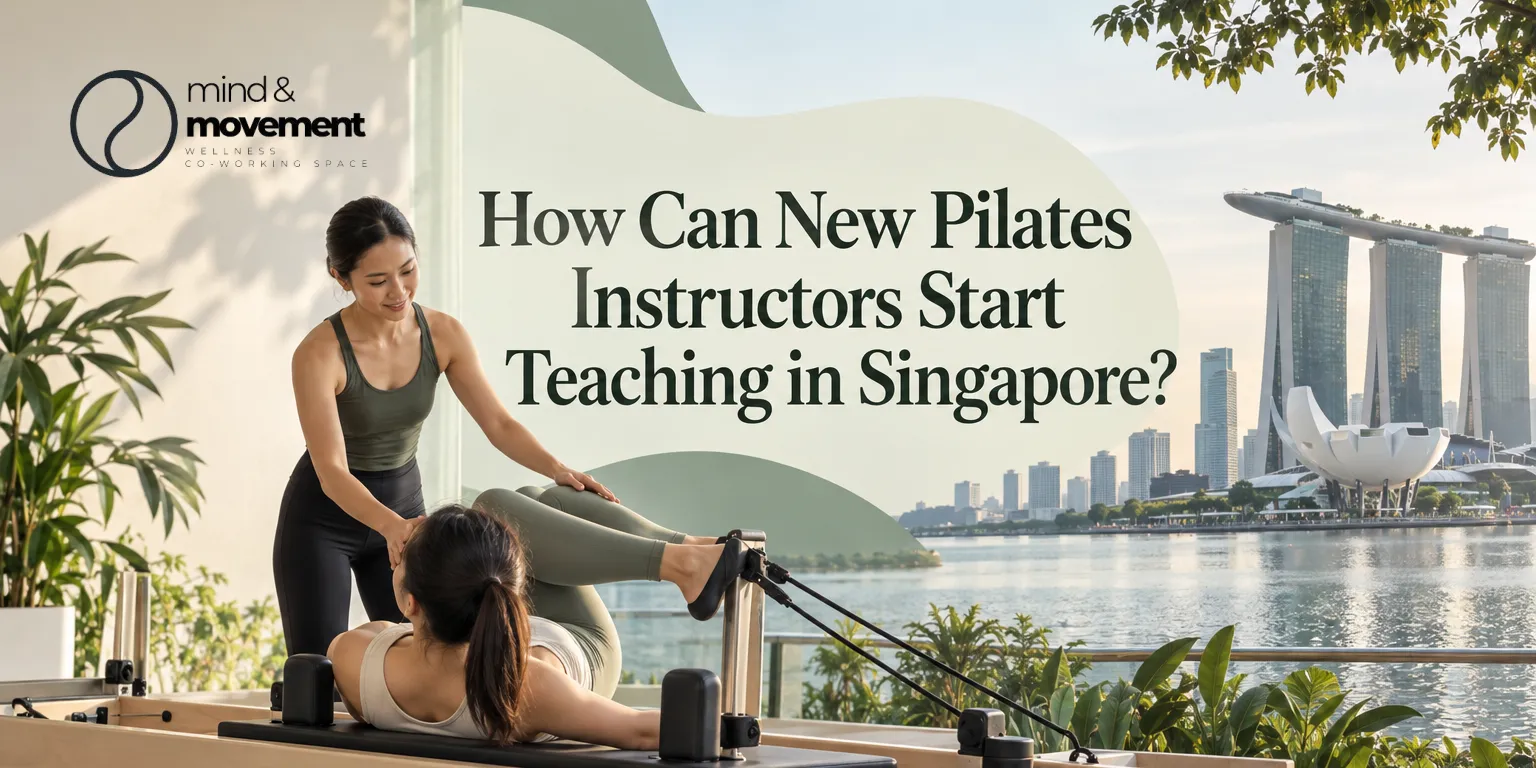
You passed your assessment. The next question is practical: how do you start teaching Pilates in Singapore with no reformer, studio, or client list? The certificate is the easy part. Everything after it comes down to rooms, equipment, rates and how you fill your diary.
Singapore makes this easier than many markets. Central studios now rent by the hour near Mass Rapid Transit (MRT) stations, with the reformers and props already in the room. That removes the lease, renovation and equipment outlay that used to decide who could teach at all.
Key takeaways:
- Singapore issues no licence for Pilates teaching; certification, first aid cover and insurance are the working baseline.
- Hourly studio rental replaces the lease, renovation and equipment purchase.
- Drop-in Pilates studio rental at Mind & Movement starts at S$35 an hour for self-practice (2026 rates).
- Register with ACRA before operating if you teach for profit regularly. Also register if you use a name other than your full NRIC name.
- An individual using only their full legal name may be exempt.
- Always view a studio in person and read the cancellation terms before you commit.
The sequence rarely changes: qualify properly, sort the admin, choose where to teach, price with the room rent in mind, then win the first ten clients. In this blog, we discuss how a new Pilates instructor in Singapore moves from certificate to first paying client, step by step.
Table of Contents
What Do You Need Before You Teach Pilates in Singapore?
A recognised certification, current first aid training and liability insurance are the practical baseline. Singapore issues no licence for Pilates teaching itself.
Start with scope. Pilates instruction is not a licensed health profession in Singapore, so no authority issues a teaching permit. Physiotherapy is different: physiotherapists must be registered with the Allied Health Professions Council under the Ministry of Health. If you are a physiotherapist who teaches, that registration governs your clinical work, not your classes.
1. Pick the certification that matches how you will teach
Mat courses are short and relatively cheap. Comprehensive apparatus training takes longer and covers reformer, trapeze table and chair. Choose the path that matches the sessions you plan to sell, and check what studios expect before you enrol.
2. Keep CPR and first aid current
Most studios and insurers expect a current cardiopulmonary resuscitation (CPR) and first aid certificate. Short refresher courses run year-round in Singapore. Book one before your first class, not after.
3. Buy instructor liability insurance
A professional indemnity or public liability policy protects you if a client is injured during a session. Check that the policy covers you on rented, third-party premises, because some exclude them.
4. Keep your scope of practice honest
Teach movement, not diagnosis. Refer clients with pain, injury or medical complexity to a registered physiotherapist or doctor, and say so plainly in your intake form.
Do You Need to Register a Business to Teach Pilates in Singapore?
Register with ACRA before operating if you teach for profit regularly or use a name other than your full NRIC name, unless an exemption applies. Teaching income is taxable either way.
You can begin as an individual earning freelance income. The cleaner route, once classes are regular, is registering a sole proprietorship with the Accounting and Corporate Regulatory Authority (ACRA). Registration is online and quick, and the fees are modest. Confirm current figures on ACRA's own pages rather than any summary, ours included.
Taxes follow. Declare teaching income to the Inland Revenue Authority of Singapore (IRAS), which administers personal income tax. Two GST rules matter later: registration becomes compulsory once taxable turnover exceeds S$1 million, and the goods and services tax (GST) rate is 9 per cent as of 2026, both per IRAS. Neither should worry a first-year instructor, but know they exist.
If you join a studio payroll instead, the employer handles most of this. If your employer participates in IRAS’s Auto-Inclusion Scheme, you do not need to declare your employment income; otherwise, declare it when required to file.
Ways to Start Teaching Compared
| Path | Upfront cost | Commitment | Best for |
|---|---|---|---|
| Hourly studio rental | From about S$35 per hour | None, book ad hoc or weekly | New instructors testing demand |
| Employment in a gym or studio | None | Fixed shifts or class slots | Teachers who want classes now |
| Your own leased studio | Deposit, renovation, equipment | A multi-year lease | Established instructors with full diaries |
Where Can New Pilates Instructors Teach in Singapore?
Three realistic paths exist:
- Rent a fully equipped studio by the hour.
- Teach inside a gym or studio as staff.
- Mix both while your diary fills.
Working out how to teach Pilates in Singapore is mostly working out where. A leased studio commits you to rent, renovation and equipment before you have clients. Hourly rental flips that order: you pay only when a client has booked, which is why most new instructors start there.
Two of our own guides go deeper. How to rent a Pilates studio in Singapore covers the viewing checklist. Our page on renting to independent instructors explains how the weekly co-working arrangement runs.
1. Rent studio time by the hour
You book a fully equipped room for a single session or a standing weekly slot. Reformers, chairs and props come with the room. You bring yourself and your client.
2. Teach inside a gym or studio as staff
Employment gives you classes immediately, with no rent or admin. The trade-off is that your rates and schedule follow someone else's model.
3. Blend both while you build
Many instructors teach part-time somewhere while running private clients from rented studios. Once privates fill the week, the balance shifts on its own.
Mind & Movement Pilates Studio Rental Rates (2026)
| Session type | Hourly rate | Available at |
|---|---|---|
| Private session | S$45 | Orchard, Somerset and Raffles Place |
| Duet | S$65 | Somerset and Raffles Place |
| Self-practice | S$35 | Somerset and Raffles Place |
| Small-group room | S$75 | Raffles Place |
What Does Pilates Studio Rental Cost in Singapore?
Drop-in studio rental at Mind & Movement starts at S$35 an hour for self-practice. Private sessions are S$45, duets are S$65 per room, and a small-group room is S$75. These are 2026 rates.
Rates in this market are published per hour, and the format matters more than the floor you teach on. A duet rate is for the room, not per client. Two clients share that room, so it costs less per person than a private. Self-practice is the cheapest way to rehearse your own programming. Membership plans with discounted hourly rates are available on request, which is how most instructors move once the week fills.
The full list of rates, inclusions and booking rules sits on our FAQ page. Read it before your first booking. What is in the room comes with the rate. Reformers, trapeze tables, chairs, barrels and props are included. WiFi and a waiting area come too. No lease, no renovation, no equipment purchase.
Registered physiotherapists who teach with apparatus rent differently. A therapy room with an electric bed and Pilates equipment rents by session length. Fresh towels and a disposable bed sheet are included. The table below shows the 2026 rates.
Physiotherapist Rates With Pilates Apparatus (2026)
| Session length | Rate |
|---|---|
| 30 minutes | S$35 |
| 45 or 60 minutes | S$45 |
| 75 minutes | S$55 |
| 90 minutes | S$65 |
| 120 minutes | S$90 |
How Do You Price Your Classes and Find Your First Clients?
Price backwards from your hourly rent and target income, then win the first ten clients through the people who already know you.
Rental arithmetic sets your floor. If a private hour costs you S$45 to rent, your fee must cover that room and your time. It must also include a margin for cancellations. Worked example: at S$45 room rent and S$80 target pay, a private session starts at S$125. If one client in five cancels, add a buffer and quote from S$130. Our fuller guide on how to price therapy sessions when renting hourly in Singapore walks through worked examples. The same logic carries over to Pilates directly.
A first workshop can introduce your teaching to several potential clients at once. Promote it through a relevant network. Our venue rental guide for wellness educators covers what to check before you run one. Check capacity, layout, and the hours that suit your audience.
1. Start with your warm network
Friends, former classmates and the school where you trained are your first pipeline. Tell people plainly that you are teaching, where, and when.
2. Run intro offers and small groups
A discounted first session lowers the barrier for strangers. Duets and small groups let price-sensitive clients share the room while you build proof.
3. Collect reviews, with consent
Ask happy clients for a public review. Under Singapore's Personal Data Protection Act (PDPA), get clear consent before using anyone's photo or story in your marketing, and keep a record of it.
4. Verify the marketing rules yourself
Check your own eligibility for a Google Business Profile before listing a rented room, and confirm what your insurer allows you to claim in ads. These rules shift, so verify them directly rather than trusting any checklist, ours included.
Three Central Studio Locations and MRT Access
| Location | Address | Nearest MRT | Hours |
|---|---|---|---|
| Orchard | Palais Renaissance, 390 Orchard Road #10-03 | Orchard, 7-10 min walk | 7am-10pm daily |
| Somerset | 111 Somerset Road #08-04 | Somerset, 5 min walk | Mon-Fri 9am-6pm, Sat 9am-1pm |
| Raffles Place | Grand Building, 17 Phillip Street #04-00 | Raffles Place, 7-10 min walk | 7am-10pm daily |
What Should You Check Before You Book Studio Time?
View the room in person, match the equipment to your training, confirm transport and hours, and read the cancellation terms before you commit.
Terms differ across providers, so run the same four checks everywhere. At Mind & Movement, bookings run through an app. A twenty-minute orientation precedes your first session. After that, you can enter and leave independently.
For the detail, check the three pages that matter. Our space rental page lists every room at each location. Our services page sets out what each booking includes. Our Orchard therapy practice location guide covers the Orchard corridor in depth. Still torn between renting and a lease? Our guide on how to compare therapy room rental and a clinic lease runs the numbers.
1. View the studio in person
Photos hide ceiling height, floor noise and how the room feels with three people in it. Book a viewing, and teach nothing sight unseen.
2. Match the equipment to your training
Equipment lists differ by location. Orchard and Raffles Place hold reformers, trapeze tables, chairs and barrels; Raffles Place adds a group room with four reformers. Somerset holds reformers, a trapeze table, chair and ladder barrel.
3. Check transport and opening hours
Orchard and Raffles Place open 7am to 10pm daily. The 111 Somerset studio runs weekday office hours plus Saturday mornings, so plan evening classes accordingly. Every location sits minutes from an MRT station.
4. Read the cancellation terms
Here, your first booking needs two days' notice; after orientation, same-day slots are possible. You can cancel in the app up to one hour before a session at no charge, and a no-show is charged the full fee.
Conclusion
Starting out is a sequence, not a leap. Qualify, handle the admin, rent rather than lease, price backwards from the room, and win clients through the people who already trust you. None of it requires a six-figure setup.
If you are working out how to teach Pilates in Singapore in 2026, hourly rental is the piece that removes the most risk. Studios from S$35 an hour for self-practice and S$45 for private sessions let you test demand before you commit to anything.
We rent fully equipped Pilates and movement studios at Orchard, Somerset and Raffles Place, each minutes from an MRT station. Message us on WhatsApp to arrange a viewing, and we will help you match the room to how you teach.
Teach From Your First Rented Hour
View the Pilates studios at Orchard, Somerset and Raffles Place, check the reformers and props in person, and see the rooms before you book. We will help you match the space to how you teach.
Frequently Asked Questions

Mind & Movement
Author
The Mind & Movement editorial team writes practical guides for independent therapists, instructors and wellness practitioners running their own practice from a rented space in Singapore, covering rooms and studios, locations, bookings and the day-to-day of building a practice.